

THE TAIWAN CALCULATION: Part III
The Chip Calculation

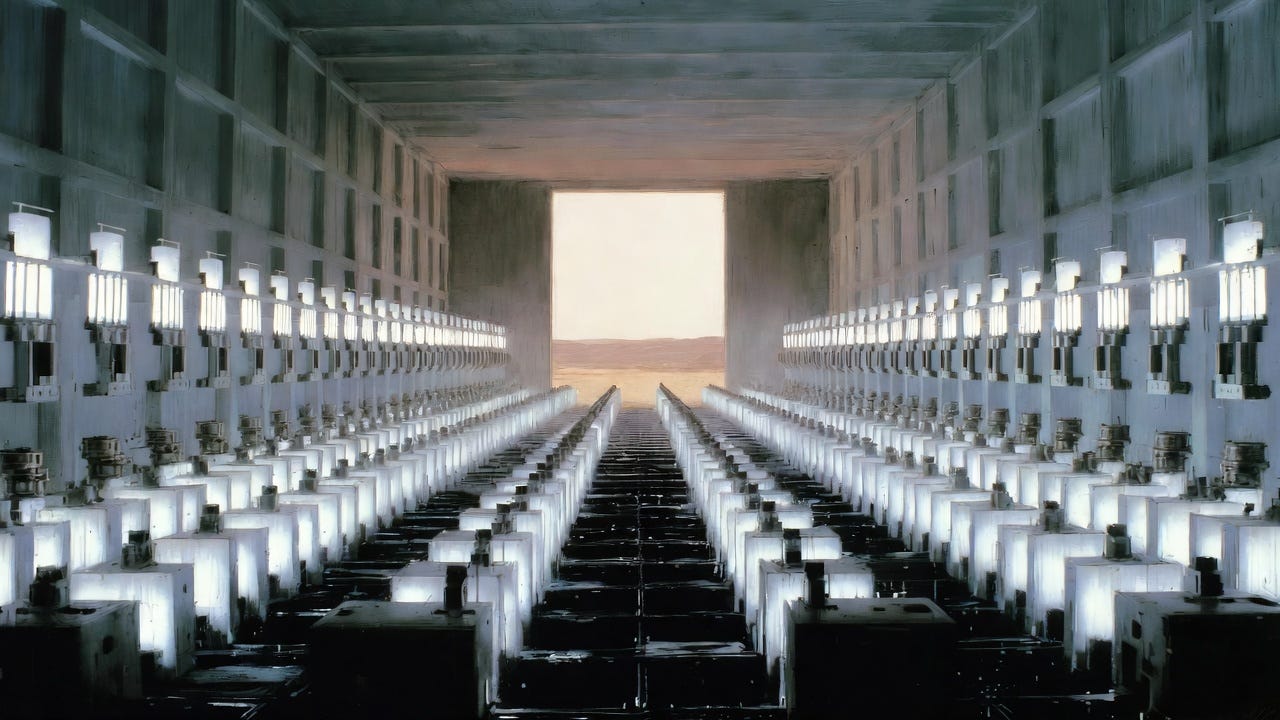
Phoenix, Arizona. A Tuesday morning in March 2025.
The facility does not look like the most strategically significant building in the Western hemisphere. It is a vast, low structure surrounded by desert, connected to the city by a highway that did not exist five years ago. The air inside is cleaner than a hospital. The workers wear full-body suits. The machines inside cost more than the GDP of several sovereign states.
TSMC Arizona Fab 1 produces chips. Specifically, it produces the three-nanometer semiconductors that go into the processors that go into the systems that run the world’s most advanced weapons platforms, artificial intelligence infrastructure, and defense communications networks. Until recently, all of those chips came from an island 120 kilometers off the coast of China.
They do not all come from there anymore.
This is not a technology story. It is a strategy story. And to understand it, you have to begin not in Arizona but in Washington, in the quiet policy discussions of the late 2010s, when a small number of American strategists began to ask an uncomfortable question. Not: how do we defend Taiwan? But: why are we structurally compelled to?
The answer they arrived at was the same answer Beijing had long understood. The United States did not protect Taiwan primarily out of democratic solidarity or treaty obligation or moral commitment to a free people’s self-determination. It protected Taiwan because Taiwan produced something without which American power could not function. Remove that dependency, and the strategic calculus shifts. Not to abandonment. To optionality. The difference, in great power terms, is everything.
The Difference Between Obligation and Choice
States that are structurally compelled to act do not negotiate. They respond. The compulsion is not a weakness in the normal sense, it is a form of credibility. An adversary knows that the response will come because the response must come. The commitment is self-enforcing.
States that have a choice negotiate differently. They weigh costs. They calculate thresholds. They ask whether this specific moment, this specific configuration of interests, justifies the price of intervention. And they sometimes decide that it does not.
American strategic policy toward Taiwan has, for three decades, benefited from the first condition while pretending to operate under the second. The ambiguity was deliberate. Washington neither confirmed nor denied a formal defense commitment. It sold Taiwan weapons and maintained unofficial relations. It kept Beijing uncertain about whether intervention would follow an attack. That uncertainty was the deterrent.
But the deterrent rested on a structural foundation that Washington did not advertise: Taiwan’s semiconductor dominance made American intervention in the event of a Chinese attack not just politically likely but economically necessary. The ambiguity was real at the diplomatic level. At the structural level, the outcome was largely predetermined.
The CHIPS Act of 2022, and the investments it triggered, is the first serious attempt to change that structural foundation. Not to abandon Taiwan. To ensure that if the moment of decision comes, Washington is choosing, rather than being compelled.
This distinction is not lost on Beijing. It is, in fact, the central variable in every Chinese strategic assessment of the Taiwan question produced in the last three years.
What the Factories Actually Mean
TSMC Arizona is the most visible element of a broader restructuring that includes Intel’s Ohio fabs, Samsung’s Texas facility, and a constellation of smaller investments in advanced packaging and chip design capacity distributed across American territory. None of these facilities, individually, replaces Taiwan. Together, over a ten-year horizon, they begin to approach something different: a diversified supply base that reduces the catastrophic single-point-of-failure that Taiwan currently represents.
The timeline matters enormously, and it is worth being precise.
By 2026, TSMC Arizona will be producing three-nanometer chips in volumes sufficient to supply a significant fraction of American defense and advanced computing requirements. By 2028, Fab 2, currently under construction, will add two-nanometer capacity. By 2030, the combined output of American-territory advanced fabrication will represent, for the first time, a meaningful alternative to full Taiwanese supply for the most sensitive American applications.
This does not mean Taiwan becomes strategically irrelevant. Taiwan will remain the world’s largest and most sophisticated semiconductor producer for the foreseeable future. The global economy will remain deeply dependent on Taiwanese production for decades. But the specific American dependency, the one that made Taiwanese semiconductor dominance a structural guarantee of American military intervention, will have begun to erode.
And that erosion opens a window. Not for Washington. For Beijing.
The Window and Its Logic
Beijing’s strategic problem with Taiwan has always had two components that pull in opposite directions. The first is the desire to act before Taiwan’s democratic identity consolidates further, before its military capabilities improve, before international support for its de facto independence hardens into something more formal. This component argues for moving sooner.
The second is the desire to act after American structural dependency on Taiwanese chips has diminished sufficiently that Washington’s response is a choice rather than a compulsion. A Washington that is choosing weighs costs differently than a Washington that is compelled. A Washington that has strategic optionality might calculate that the price of military intervention over Taiwan, measured in American lives, economic disruption, and potential nuclear escalation, exceeds the benefit of restoring a status quo that its own industrial policy has already begun to supersede. This component argues for moving later.
The window that Beijing is watching is the period during which both conditions are simultaneously met. Taiwan’s military and political position still vulnerable enough to be overcome quickly. American structural dependency reduced enough that intervention is a genuine political choice rather than an economic necessity.
That window, based on the trajectories described above, opens somewhere around 2028 and reaches its widest point between 2029 and 2031. It begins to close again as Taiwan’s own defense investments mature, as Japanese and South Korean military capabilities increase, and as the second and third order effects of American onshoring become fully visible.
This is not a guess. It is the output of a calculation that Beijing has been running, with considerable analytical sophistication, for years. The factories in Arizona are not invisible to Chinese intelligence. They are, in all likelihood, better mapped and better understood by Chinese planners than by most Western strategic analysts.
The Signal Washington Is Sending
There is a harder question embedded in the chip onshoring strategy, one that American policymakers have been careful not to articulate publicly, but which is legible in the structure of the policy itself.
By building domestic semiconductor capacity, Washington is not just reducing economic vulnerability. It is, deliberately or not, sending Beijing a signal about the future of American commitment to Taiwan. The signal is not: we are abandoning Taiwan. The signal is: we are building the conditions under which our commitment will be a matter of political will rather than structural compulsion.
For an American audience, this reads as prudent strategic diversification. For Beijing, it reads as something more specific: an acknowledgment that the structural guarantee is temporary, and that the political guarantee that must replace it is less certain.
This is not necessarily a miscalculation on Washington’s part. The alternative, permanent structural dependency on a single island as the guarantor of American defense industrial capacity, is its own form of strategic vulnerability. But it creates a transition period during which the deterrent architecture that has kept the Taiwan Strait stable for fifty years is being rebuilt on different foundations. And transition periods, in geopolitical history, are when the accidents happen.
The Question the Factories Cannot Answer
The chip onshoring strategy answers one question: can America afford, economically, to allow Taiwan to fall? By 2030, the answer to that question will be: yes, at some cost, in some scenarios.
It does not answer the question that actually determines Beijing’s calculation: will America pay the military and political price of intervention, when the structural compulsion has been reduced and the decision rests on political will alone?
That question leads directly to the actors who have the most at stake in the answer. Not Washington. Not Taipei. Tokyo and Seoul. The states that sit on the first island chain, that host American forward deployments, that have built their entire security architecture on the assumption that American structural compulsion and political will point in the same direction.
What happens to that architecture when the structural compulsion begins to erode? What does Japan calculate when the factories in Arizona are running at full capacity and a Chinese operation over the Taiwan Strait is no longer an attack on the American economy, but a test of American political resolve?
That is the question Part IV will answer. And it is, in the end, the question on which everything else depends.
The Taiwan Calculation continues with Part IV: The First Line Trembles.