

The Frozen Trap
A ceasefire without guarantees is not peace. It is the opening move of the next war.

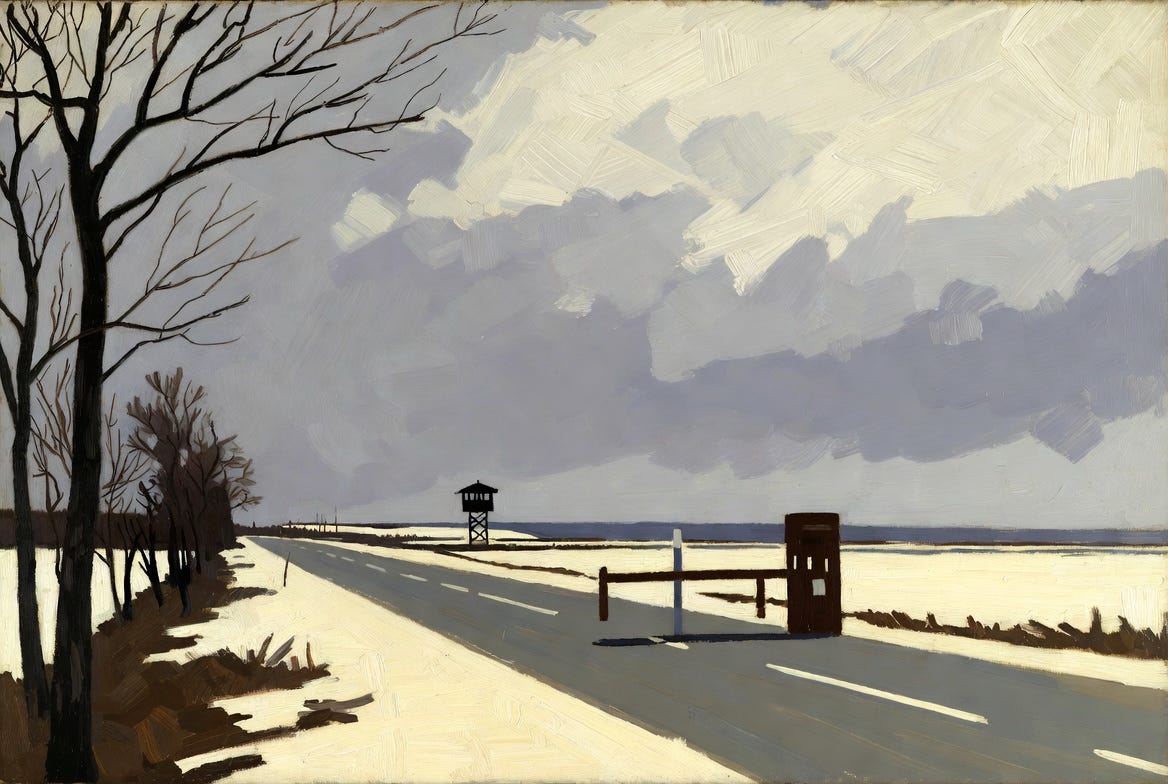
On the morning of February 24, 2022, Russian armoured columns crossed into Ukraine from three directions. The offensive that was meant to last seventy-two hours has now lasted more than three years. The capital did not fall. The Ukrainian state did not collapse. And Russia, which entered the war expecting a political settlement within a week, has spent the intervening years discovering what every army discovers when a short war becomes a long one: that the costs accumulate faster than the objectives clarify.
The war is now entering its most dangerous phase, and the danger does not come from the front. It comes from the negotiating table. A ceasefire is being discussed in Washington, in European capitals, and in back channels that have not yet been made public. The outlines of what Washington wants are clear enough: a halt to the fighting along something approximating the current line of contact, an end to American financial exposure, and a political arrangement that allows the Trump administration to declare a result. What is not clear, and what will determine whether the next decade in Europe is stable or catastrophic, is whether any ceasefire comes with security guarantees that make it durable.
This analysis does not take a position on what the outcome should be. It maps the structural logic of the situation, the fractures inside the actors that official positions conceal, the economic architecture that shapes real decisions, and what each possible outcome means for the states that have the most to lose.
The Frontline States and What They Cannot Afford
The states closest to the conflict are also the states with the least margin for error. Ukraine, Poland, and the Baltic states share a common strategic problem: they are all downstream of decisions made in Washington and Moscow, and they are all running out of time to shape those decisions before they are made without them.
Ukraine’s position is defined by a single structural constraint. Three years of war have demonstrated that the Ukrainian state is more resilient than anyone expected. It has held. But resilience is not the same as capacity for victory. The front has stabilised at a level of attrition that Ukraine can sustain only as long as Western financing and ammunition supply continues at current levels. The Ukrainian state budget is currently running a deficit of approximately thirty-five billion dollars annually, financed roughly two-thirds by Western government transfers and one-third by domestic borrowing at rates that would be unsustainable without the implicit guarantee of external support. The moment that supply compresses, the military and fiscal equations shift simultaneously. A ceasefire without NATO membership or an equivalent security guarantee does not end the war for Ukraine. It ends the current phase of it. Russia retains the occupied territories, consolidates its military capacity during the pause, and returns to the question of Ukrainian statehood at a time of its choosing.
Poland has spent the years since 2022 doing something that European states had largely forgotten how to do: building an army. Warsaw’s defence budget now exceeds four percent of GDP, the highest in NATO. Its land forces are in the process of a modernisation programme that will make the Polish military the largest conventional ground force in the European Union by the end of this decade. Poland’s bet is that a Europe capable of defending itself changes the deterrence calculation for Moscow in a way that American commitments alone, subject to electoral volatility in Washington, cannot. That bet is coherent. But it is a bet with a long time horizon, and the ceasefire question will be decided before Poland’s rearmament programme reaches its intended endpoint.
The Baltic states are the most exposed and the most clear-eyed. Estonia spends over three percent of GDP on defence. Latvia and Lithuania are close behind. All three have mandatory military service. All three have requested and received increased NATO force presence on their territory. The reason is structural: a ceasefire that leaves Russia in possession of Ukrainian territory, without a credible mechanism to prevent further revisionism, restores the strategic logic that made the 2022 invasion possible. The Baltic states are not making an emotional argument about solidarity with Ukraine. They are making a rational argument about the architecture of their own security.
The Fractures That Official Positions Conceal
States present unified positions to the outside world. They rarely are. The fractures inside the main actors are as important as the positions between them, and they are the dimension that most analyses of this conflict consistently underweight.
Inside Ukraine, the most consequential fracture runs between the political leadership and the military command. President Zelensky’s political survival depends on a narrative of resistance and eventual restoration. The military command, led by General Syrskyi, operates on a more granular assessment of what the force can sustain. Those two positions are not always identical, and the gap between them widens as the war extends and the prospect of Western disengagement becomes more concrete. A second fracture runs between Kyiv and the oligarchic structures that survived 2022 with their economic positions largely intact. Ukraine’s ten largest business groups control assets spanning energy, metals, agriculture, and media. Their interest in a ceasefire, even an imperfect one, is more immediate than Zelensky’s political interest in holding out for guarantees. That pressure is not visible in official communications. It is visible in the lobbying that reaches European capitals through intermediaries. Any serious assessment of Ukrainian negotiating behaviour must account for it.
Inside Poland, the fracture between Prime Minister Tusk and President Duda is not merely a domestic political inconvenience. On foreign and security policy, the Polish constitution gives the president substantial formal powers over military deployment and treaty ratification. Tusk’s government has driven the European security debate with unusual boldness. Duda has periodically complicated or delayed its execution. A European guarantee architecture that requires Polish parliamentary ratification and presidential signature is not a guarantee architecture that can be assembled quickly or cleanly. Warsaw’s external posture is more coherent than its internal political structure currently supports.
Inside Russia, the relevant fracture is between the logic of continued war and the logic of economic stabilisation. The Russian defence sector is producing at elevated rates and the war economy has demonstrated more resilience than Western sanctions architects anticipated. But the inflation pressures generated by wartime spending are real, the labour market is distorted by both military mobilisation and emigration of skilled workers, and the long-term cost of demographic losses is not yet reflected in current economic indicators. The Russian elite that benefits from war contracts is not the same elite that suffers from import restrictions and capital controls. Putin’s political management of that tension has been effective, but it is not effortless, and the further the war extends without a decisive outcome, the more that management cost accumulates.
The Western fragmentation is equally internal. Germany’s new government faces a defence budget debate whose outcome is not predetermined. France’s domestic political instability constrains Macron’s ability to translate his rhetorical boldness on European security into binding commitments. Hungary’s Orban has structural incentives to maintain his Moscow adjacency as long as it produces domestic political dividends. And within the United States, the gap between the Trump administration’s stated desire for rapid disengagement and the Pentagon’s institutional assessment of what American withdrawal from the European security architecture would cost is wider than public statements suggest.
The Economic Architecture of the Conflict
Wars are decided on the battlefield but sustained by balance sheets. The economic dimension of the Ukraine conflict is not a secondary consideration for strategic actors; it is the primary constraint on every political decision.
Ukraine’s fiscal dependency is structural and acute. Western government transfers, primarily from the United States, the European Union, and the IMF, have financed the gap between Ukrainian government revenues and expenditures since 2022. The United States alone has provided approximately one hundred billion dollars in combined military and financial assistance. European governments have contributed a comparable amount through bilateral channels and EU instruments. Without this transfer architecture, the Ukrainian state cannot pay its civil servants, maintain its social services, or sustain its military at current levels. This dependency is Kyiv’s central vulnerability in any negotiation: the threat of supply reduction is the lever Washington is using, and it is a real lever.
The frozen Russian sovereign assets present a separate economic dimension. Approximately three hundred billion dollars in Russian central bank assets are currently immobilised in Western, primarily European, financial institutions. The interest generated by those assets has been redirected toward Ukraine. The legal and political question of whether the principal itself can be seized and transferred has not been resolved. For European financial institutions holding those assets, the uncertainty creates a persistent compliance and reputational exposure that will need to be resolved in any of the three scenarios below. For any reconstruction financing architecture, the status of those assets is not a technical footnote; it is one of the primary financing instruments available.
A third economic dimension has opened in 2026 that was not visible when the war began. Ukraine’s defense cooperation agreements with Saudi Arabia, the UAE, and Qatar, signed in late March 2026, represent the first systematic emergence of Ukraine as a security exporter rather than a security importer. Ukrainian interceptor drones, developed at a cost of one to five thousand dollars per unit against Russian aerial campaigns, solve a problem that Gulf militaries have been managing with Patriot and THAAD missiles costing four to fifteen million dollars each. The Gulf deals provide Ukraine with two things simultaneously: a nascent revenue stream from defense exports and co-production arrangements, and political capital that complicates the narrative of Ukraine as a purely dependent actor. Neither changes the fundamental fiscal arithmetic in the short term. The annual budget deficit remains, and Gulf defense revenue does not substitute for Western government transfers at current scale. But the Gulf corridor is a structural development with a longer arc: Ukraine is building institutional relationships with states that spend more per capita on defense than almost anywhere on earth, and those relationships will outlast the immediate operational crisis that created them.
European corporate exposure to Russia has contracted dramatically since 2022 but has not reached zero. Energy relationships, financial exposures, and supply chain dependencies that were built over three decades do not unwind in two years. The firms that remain most exposed are not primarily in energy, where the political pressure to exit has been most intense, but in industrial inputs, logistics infrastructure, and financial services with legacy positions that are difficult to exit cleanly. Those firms have a material interest in a ceasefire, even an imperfect one, that reduces the political pressure for complete decoupling. That interest does not translate directly into political lobbying, but it shapes the risk appetite of European governments that are simultaneously managing security policy and economic policy with the same set of relationships.
The Fragmentation Problem Inside the West
The Western position is not unified. It is divided along lines that Russia understands well and has consistently exploited.
The United States under the current administration has a fundamentally different assessment of the conflict than the frontline states. Washington’s view is that the war is a European problem that Europeans have outsourced to American financing, and that the bill has become politically unsustainable. The consequence is that Washington’s preferred outcome, a ceasefire on terms that allow American disengagement, is structurally at odds with Kyiv’s preferred outcome, a ceasefire on terms that make Ukrainian survival durable.
France and the United Kingdom have been the most willing to discuss European security guarantees, including the possibility of European forces as a monitoring or deterrence presence in Ukraine after a ceasefire. Germany remains the pivotal actor and the most structurally ambivalent. A European guarantee architecture that excludes German participation is not credible at the scale required. Hungary within the EU maintains a posture of deliberate ambiguity that gives Moscow a consistent lever inside the European institutional framework.
China’s role is the least visible and the most consequential below the surface. Beijing has provided Russia with economic support that has materially extended the war’s duration, through trade relationships, technology transfers, and financial arrangements that partially offset Western sanctions. Its preferred outcome is a frozen conflict that keeps Russia intact, keeps America distracted, and keeps Europe divided and unable to consolidate as a strategic actor. That preference maps almost exactly onto the Base Case below, and it is worth stating explicitly: China is the one major external power whose strategic interests are best served by the most likely scenario. That alignment is not coincidental, and it is not passive.
The Pivotal Variable
The central variable is the content of any ceasefire agreement’s security provisions. A ceasefire with NATO membership for the unoccupied territory of Ukraine, or with a legally binding Article 5-equivalent guarantee from a coalition of European states, changes the strategic calculus for Moscow in a durable way. A ceasefire without such provisions is a pause. Russia retains the occupied territories, uses the interval to rebuild, and retains the option to resume when the balance of forces is more favourable. That is the variable on which the three scenarios below turn.
Scenario One: Ceasefire with Durable Guarantees
Premise: Western financial and military support holds at levels sufficient to make continued Russian offensive operations prohibitively costly, which compels Moscow to accept terms. A ceasefire is reached along approximately the current line of contact. The unoccupied territory of Ukraine receives a credible security guarantee through accelerated NATO accession or a European-led Article 5-equivalent commitment. Reconstruction financing begins.
This is the least likely scenario, and the analysis treats it accordingly. It requires three conditions to align simultaneously: sustained Western support through the negotiation period, a European guarantee architecture with genuine German participation, and a Russian calculation that settlement is preferable to continued attrition. None of these conditions is currently present. The scenario is mapped not because it is probable but because it defines the ceiling of what is achievable and the benchmark against which the other two scenarios should be measured.
Ukraine accepts the loss of occupied territories as a de facto reality while preserving the legal position that those territories remain Ukrainian under international law. The frozen Russian sovereign assets are unfrozen and redirected toward reconstruction financing, resolving the legal ambiguity that European financial institutions have been managing since 2022. Private capital, priced out of the market by political risk, re-enters. The reconstruction opportunity is the largest in Europe since the Marshall Plan, spanning infrastructure, energy, agriculture, digital, and manufacturing across a country of forty million people with a skilled industrial workforce.
For Poland and the Baltic states, this scenario vindicates the strategic investments of the past three years. Warsaw becomes a primary pillar of European security architecture rather than a forward outpost. The Baltic states redirect political energy from existential crisis management toward institutional development. China does not benefit: a stabilised and reconstructing Ukraine integrated into European security structures demonstrates precisely the Western institutional coherence that Beijing has been working to prevent.
The internal fractures described above do not disappear in this scenario, but they become manageable. Zelensky’s political narrative has a resolution. The Ukrainian military command has a defined endpoint. The oligarchic structures have a reconstruction economy to position themselves within. The Polish political fracture between Tusk and Duda is resolved by a treaty that gives both sides something they can claim. The Gulf defense corridor reinforces Kyiv’s negotiating position in this scenario: a Ukraine that is simultaneously a NATO candidate, a reconstruction partner for European capital, and an established security exporter to the wealthiest states in the Middle East is a fundamentally different diplomatic actor than the Ukraine of 2022. That expanded external footprint makes it harder for any party to treat Ukraine as a passive object of great power negotiation.
Scenario One opens the largest European reconstruction opportunity in a generation. The entry window is during the guarantee negotiation, before the legal architecture is finalised. The resolution of the frozen asset question is the financing signal: firms tracking this scenario should treat movement on the three hundred billion dollar asset question as the leading indicator that Scenario One is materialising. Early positioning in framework agreements carries structural advantages over later competitive entry.
Scenario Two: Frozen Conflict Without Guarantees
Premise: A ceasefire is reached under American pressure along approximately the current line of contact. No credible security guarantee is provided. Ukraine is not offered NATO membership. European states disagree on any alternative guarantee architecture. The conflict freezes. Russia consolidates. Ukraine survives but remains in a permanent grey zone between war and peace.
This is the most likely scenario, because it is the outcome that requires the least from the actors with the most leverage. Washington achieves disengagement. Russia achieves a territorial gain without a binding constraint on future action. Europe continues its rearmament without the strategic coherence that a defined commitment would require. China observes the outcome with quiet satisfaction. Ukraine survives, formally sovereign over the unoccupied territory, but without the security infrastructure that would make that sovereignty durable.
The economic consequences are immediate and structural. The frozen Russian sovereign assets remain frozen: no ceasefire without a peace treaty creates the legal basis for their transfer, and a frozen conflict without a peace treaty is precisely what this scenario produces. European financial institutions continue to carry the compliance and reputational exposure of holding those assets indefinitely, without the clarity that either full seizure or return would provide. The Ukrainian state budget deficit remains, reduced somewhat by the end of active combat operations but not eliminated: a country that has lost one-fifth of its territory, a significant portion of its industrial base, and several million of its most mobile citizens to emigration does not balance its books when the shooting stops.
Reconstruction financing begins cautiously, in sectors with short payback periods and limited fixed-asset exposure. But the signal to private capital is structurally ambiguous: the fighting has paused, but the question of whether it is over has not been answered. Project finance for long-duration infrastructure requires a political risk framework that no insurer or development bank will provide without a guarantee architecture that this scenario explicitly lacks. The reconstruction market exists but trades at a significant discount to its potential.
The internal fractures widen under this scenario in ways that compound over time. In Ukraine, the gap between Zelensky’s political need for a narrative of resistance and the military command’s operational assessment of a sustainable posture becomes increasingly difficult to manage in a frozen conflict without resolution. The oligarchic pressure for normalisation accelerates as the wartime political consensus weakens. The ceasefire produces genuine relief for the population, but it does not produce the answer to the question that has organised Ukrainian political life since 2022: whether the country will survive as a Western-oriented sovereign state. That unresolved question is a source of sustained internal instability that external actors, including Russia, will exploit.
Poland and the Baltic states respond by accelerating their own rearmament and formalising their de facto sub-alliance within NATO. Warsaw consolidates its role as the anchor of eastern European security, deepening bilateral defence agreements with Scandinavia, the Baltic states, and Romania. For the Baltic states, the frozen conflict without guarantees validates every investment they have made in domestic military capacity and every argument they have made in European institutions. They become louder and more insistent voices within the EU and NATO, not because their position has changed but because the scenario has confirmed it.
Russia uses the pause to rebuild. The specific bottleneck is not hardware but trained manpower: experienced junior officers, non-commissioned officers, and the institutional knowledge that three years of attritional warfare destroys faster than it can be replaced. Realistic assessments of Russian military reconstitution suggest a minimum of five to seven years to restore a force capable of sustained offensive operations against a defended opponent. That timeline is long enough that the frozen conflict appears stable in the short term. It is short enough that it falls within the planning horizon of every serious defence ministry from Warsaw to Tallinn. China continues its quiet economic support for Russia throughout this period, sustaining the reconstitution timeline and ensuring that Western sanctions do not compress it further.
Scenario Two supports selective commercial engagement under an explicit political risk framework. Sectors viable under this scenario: advisory, logistics, agricultural commodity trading, digital infrastructure, short-cycle manufacturing. Sectors requiring scenario hedging: energy infrastructure, long-duration construction, financial services with fixed-asset exposure. The frozen asset question is the single most important legal risk for European financial institutions: internal legal reviews of Russian sovereign asset exposure should be completed and contingency positions established regardless of which scenario materialises. Supply chain routing through Poland and the Baltic states carries lower political risk than direct Ukraine entry for firms with shareholders sensitive to geopolitical exposure.
Scenario Three: Collapse of the Ceasefire Architecture
Premise: A ceasefire is reached under American pressure without guarantees. Ukraine’s internal political cohesion fractures progressively under the weight of an unresolved outcome. Russia completes its military reconstitution within five to seven years. The Western political environment does not produce a second emergency mobilisation at the scale of 2022. Russia resumes military operations against a Ukraine that is militarily weaker, politically divided, and strategically isolated.
This scenario does not require Russian aggression in the immediate term. It requires only that the conditions created by Scenario Two be allowed to develop to their structural conclusion. The five to seven year reconstitution timeline is not speculation; it is derived from the documented depletion rates of specific Russian military capabilities and the production and training rates of the Russian defence establishment. It is the planning horizon that serious defence ministries in Warsaw, Tallinn, Riga, and Vilnius are already working with.
The mechanism operates through the internal fractures before it operates through the military balance. A ceasefire without guarantees does not resolve the question of Ukrainian sovereignty; it suspends it. The political mobilisation that made Ukrainian resistance possible in 2022 depended on a clear external threat and a clear defensive purpose. A frozen conflict replaces that clarity with a question that has no good answer: what was the sacrifice for? The gap between Zelensky’s political narrative and the military command’s operational assessment widens into a governance crisis. The oligarchic pressure for accommodation with whatever political framework allows asset preservation reasserts itself. The ceasefire that was presented as a pause becomes, in the internal Ukrainian political discourse, a defeat that no one is willing to name as such. A Ukraine that is politically fragmented and operating under a fiscal architecture that Western donors are progressively less willing to sustain is a different opponent than the Ukraine of 2022.
Russia, observing this process, calculates on the basis of three factors: its own military reconstitution, the degradation of Ukrainian political cohesion, and the Western political appetite for a second emergency mobilisation. On the third factor, its assessment will be more permissive than in 2022. The Western response to the original invasion was historically exceptional: a rapid, unified financial and military mobilisation that exceeded most prior expectations. That response was driven partly by the shock of the event itself. A second Russian offensive, following a ceasefire that the West endorsed and a pause that the West allowed Russia to use for reconstitution, would not carry the same shock effect. The internal fractures in European governments, the German structural ambivalence, the Hungarian lever, the American political variability, are all more advanced in the period following a frozen conflict than they were in February 2022. The political conditions for a second emergency mobilisation are structurally weaker than they were for the first.
The economic consequences arrive before the military ones. The moment a resumed Russian offensive becomes a serious analytical probability rather than a tail risk, the risk premium on all Eastern European exposure reprices. That repricing is not limited to Ukraine. It affects Poland, the Baltic states, Romania, and through supply chain and financial exposure, the wider European economy. European firms that retained legacy positions in Russian markets under the cover of the frozen conflict face a second round of forced divestiture under worse conditions than the first. The frozen Russian sovereign assets, still unresolved from Scenario Two, become the subject of emergency legal proceedings in multiple jurisdictions simultaneously.
For Poland, this scenario transforms the strategic bet of the past three years into an immediate operational question that arrives before the rearmament programme reaches its intended endpoint. The internal fracture between Tusk and Duda becomes a constitutional crisis at precisely the moment when decision speed matters most. For the Baltic states, a second Russian military success against Ukraine, following a ceasefire that the West endorsed, demonstrates that the NATO guarantee is subject to American electoral cycles in a way that fundamentally alters its deterrence value. Tallinn, Riga, and Vilnius face a choice between accepting a permanently precarious security position and taking unilateral actions whose instability dynamics are unpredictable. China observes the collapse of Western institutional credibility in its most consequential post-Cold War test and draws the conclusions relevant to its own calculations regarding Taiwan.
Scenario Three triggers a fundamental reassessment of Eastern European exposure across all asset classes, with an affected perimeter extending well beyond Ukraine to Poland, the Baltic states, and Romania. The exit or hedge signal is not the resumed offensive itself but the leading indicators in the twelve to eighteen months that precede it: collapse of Ukrainian internal political consensus, Russian military reconstitution crossing the operational threshold, and Western political discourse that has normalised the possibility of a second offensive rather than treating it as unacceptable. European financial institutions with legacy Russian sovereign asset exposure face the highest acute legal risk in this scenario. Any firm operating in Eastern Europe without a defined Scenario Three contingency plan is carrying unpriced tail risk.
Structural Verdict
The Ukrainian war will not end with a peace agreement. It will end, if it ends, with an arrangement that one side calls a ceasefire and the other calls a pause. The difference between those two words is the entire content of the security question.
Scenario Two is where the structural logic of the current moment points. Washington wants out. Moscow wants time. Europe wants stability without the commitment that stability requires. China wants exactly this outcome and is quietly working to sustain the conditions that produce it. The internal fractures in every major actor, the Ukrainian oligarchic pressure for normalisation, the Polish constitutional friction, the German structural ambivalence, the American political variability, all point in the same direction: toward the path of least resistance, which is a ceasefire without guarantees dressed as a diplomatic achievement.
The instability of Scenario Two points in one direction: toward Scenario Three. The transition is slow enough that it passes through multiple decision points where course correction remains possible. One variable that was not present at the war’s outset partially slows that trajectory: Ukraine’s emerging role as a security exporter. The Gulf defense corridor, built through defense cooperation agreements with Saudi Arabia, the UAE, and Qatar in early 2026, does not change the fundamental guarantee deficit and does not substitute for Western financing at scale. But a Ukraine that has built institutional relationships across the Middle East, and that has demonstrated battlefield-tested capabilities that the wealthiest defense buyers on earth are willing to pay for, is harder to isolate and harder to abandon than a Ukraine that depends exclusively on Western goodwill. That does not make Scenario Three structurally unlikely. It makes the transition slower and more contested than a pure dependency analysis would suggest. The structural logic remains unforgiving. The same internal fractures that make Scenario Two politically achievable simultaneously make Scenario Three more likely with each year that passes without a genuine guarantee architecture. The states whose security depends on that architecture know this. They have said so clearly and repeatedly. They have been heard, and not listened to.
The economic dimension of this analysis is not separable from the security dimension. The frozen sovereign assets, the Ukrainian fiscal dependency, the European corporate exposure, and the reconstruction financing question are not technical matters to be resolved after the political decisions are made. They are the material through which political decisions are expressed and constrained. The firms and institutions that understand that connection will be better positioned than those that treat the security and economic questions as separate problems with separate experts.
The security architecture of Europe for the next generation is being decided now, not in a single summit or document, but in the accumulation of smaller decisions about financing levels, ceasefire language, and whether a guarantee means something enforceable or something convenient. Those decisions are being made by governments whose domestic political horizons are shorter than the consequences of their choices. The states that will live with those consequences longest are not the ones making them. They are Kyiv, Warsaw, Tallinn, Riga, and Vilnius.
The Frozen Trap
A ceasefire without guarantees is not peace. It is the opening move of the next war.
Response to Ludwig J. Marx
There is a severity in your framing that feels justified.
A ceasefire without guarantees is not peace. It is, as you write, the opening move of the next war.
And yet, what strikes me most in your analysis is not the scenarios themselves, but the quiet convergence behind them.
Because what you describe is not primarily a failure of strategy.
It is a convergence of constraints.
Washington seeking disengagement
Moscow seeking time
Europe seeking stability without full commitment
Ukraine seeking survival within narrowing margins
Individually, each position is understandable.
Together, they produce exactly the outcome you identify.
Your distinction between a ceasefire and a pause is essential.
But I would extend it slightly.
A ceasefire without guarantees is not only a pause in fighting.
It is a reallocation of pressure.
From the battlefield to:
political systems
fiscal structures
alliance cohesion
The war does not stop.
It changes location.
What makes your Scenario Two so compelling is precisely that it requires the least alignment.
It is the path of lowest resistance within a system that is already under strain.
But that is also what makes it unstable.
Not immediately.
But structurally.
I find your analysis of internal fractures particularly important.
Because these fractures are not incidental.
They are load-bearing.
Ukraine: political narrative vs. military sustainability
Poland: strategic clarity vs. constitutional friction
Russia: war economy vs. long-term stability
West: commitment vs. political horizon
A ceasefire without guarantees does not resolve these tensions.
It redistributes them over time.
And time, in this case, is not neutral.
It favours the actor best able to use it.
That is the uncomfortable implication behind your transition from Scenario Two to Scenario Three.
Not inevitability—but direction.
Where I would add a layer is on the system itself.
Because the guarantee problem you describe is not only political.
It is structural.
A guarantee is credible only if:
it is backed by capability
it is supported by political will
it is insulated from short-term cycles
At present, none of these conditions are fully stable.
Which is why the system gravitates toward ambiguity.
Your economic dimension reinforces this.
The frozen assets, the fiscal dependency, the hesitant capital— these are not secondary.
They are the constraints within which every political choice is made.
And in a frozen conflict, those constraints do not ease.
They compound.
The most striking line in your piece may be the simplest:
that the states who will live longest with the consequences are not the ones making the decisions.
That asymmetry is not new.
But it is particularly sharp here.
So perhaps the conclusion is not only that a ceasefire without guarantees risks the next war.
It is that:
the system is currently structured to produce exactly such ceasefires— because they resolve immediate pressure without resolving underlying constraints.
And that is why they recur.
Which leaves the real question not whether Scenario Two is likely.
It is whether anything in the current structure is strong enough to resist it.
And at the moment, it is not obvious that there is.